Contract Testing: The Safety Net Your Microservices Architecture Needs
A practical guide to preventing integration nightmares with bi-directional contract testing

The Problem We All Face
Picture this: It's Friday afternoon. Your team just deployed a new version of your payment service. Everything looked good in testing. Your CI/CD pipeline was green. Then the alerts start flooding in.
The mobile app is crashing. The checkout process is broken. Customers can't complete purchases. You quickly roll back, but the damage is done. What went wrong?
Your payment service changed a field type from string to number. A tiny change. Your service's tests passed. But three consumer applications expected that string format, and they all broke simultaneously.
Sound familiar? If you've worked with microservices, you've probably lived through this nightmare. And if you haven't yet, trust me – you will.
The Microservices Integration Challenge
When we moved from monoliths to microservices, we gained independence. Teams could deploy faster. Services could scale independently. Life was good! Until it wasn't.
Here's what we lost:
1. Compile-Time Safety
In a monolith, if you change an interface, the compiler tells you what breaks. With microservices? Good luck finding all the consumers.
2. Clear Ownership
Who's responsible when integration breaks? The provider who changed the API? The consumer who made assumptions? Both? Neither?
3. Testing Confidence
Your unit tests pass. Your integration tests pass. But did you test against every consumer's expectations? All their edge cases? Probably not.
4. Deployment Confidence
Can you safely deploy your service right now? Who knows what will break? The only way to find out is to deploy and hope for the best.
The traditional solutions don't really work:
- •End-to-end tests: Slow, brittle, expensive to maintain
- •Manual coordination: Doesn't scale, error-prone
- •"Hope and pray" deployment: Not a strategy
- •Integration environments: Always broken, never match production
There has to be a better way.
Enter Contract Testing
Contract testing flips the problem on its head. Instead of testing actual services talking to each other, we test the agreements between them.
Think of it like this: When you rent an apartment, you don't need to live there for a year to know if the landlord will fix things. You have a contract. If the landlord violates it, you know immediately.
Same idea with services. Define the contract. Test against it. Both sides. Independently. Fast.
The magic happens because:
Consumers define what they need
Not what providers think they need
Providers verify they deliver it
Against real expectations, not assumptions
Both can test independently
No need to spin up the other service
You know before deployment
Not after customers complain
This is bi-directional contract testing. The consumer creates the contract from their tests. The provider verifies against it. A broker manages everything in between.
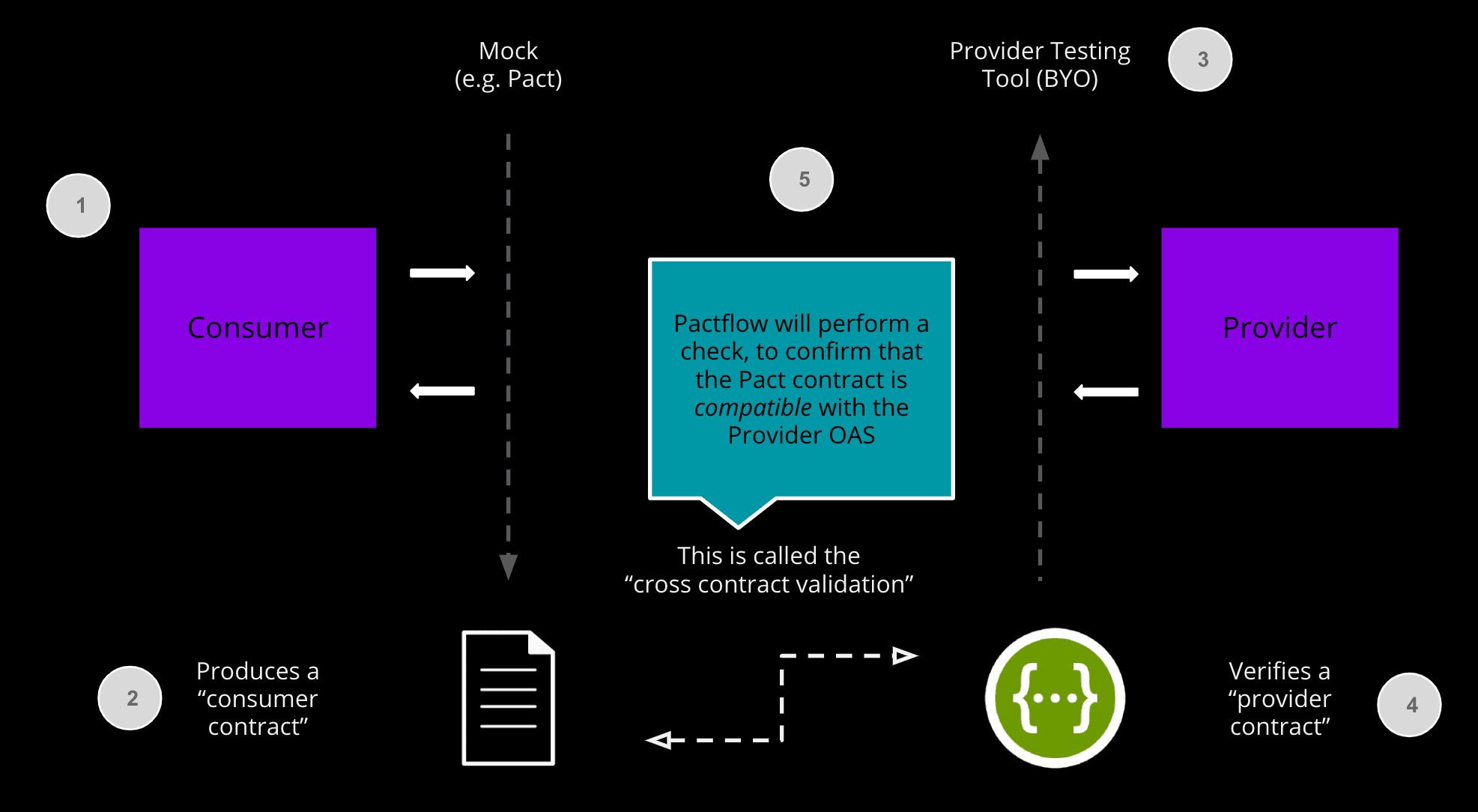
Bi-directional contract testing workflow: Consumer generates contracts, Broker manages them, Provider verifies
How Contract Testing Actually Works
Let me walk you through the process. I'll keep it simple.
1Phase 1: Consumer Creates the Contract
Let's say you're building a checkout page that needs to process payments. You don't want to call the real payment service in your tests. You also don't want to mock it blindly.
Instead, you write a Pact test:
// Consumer test
it('should authorize a payment', async () => {
  // 1. Set up expectations
  await provider.addInteraction({
    state: 'a valid payment card',
    uponReceiving: 'a request to authorize payment',
    withRequest: {
      method: 'POST',
      path: '/api/payments/authorize',
      headers: { 'Content-Type': 'application/json' },
      body: {
        cardNumber: '4111111111111111',
        amount: '100.00',
        currency: 'USD'
      }
    },
    willRespondWith: {
      status: 200,
      headers: { 'Content-Type': 'application/json; charset=utf-8' },
      body: {
        transactionId: like('txn_abc123'),
        status: 'authorized',
        amount: '100.00'
      }
    }
  });

  // 2. Test your actual code
  const result = await paymentClient.authorizePayment({
    cardNumber: '4111111111111111',
    amount: '100.00',
    currency: 'USD'
  });

  // 3. Verify it worked
  expect(result.status).toBe('authorized');
});
What just happened?
- 1.You told Pact what you expect from the provider
- 2.Pact created a mock provider that responds exactly like that
- 3.Your real client code ran against this mock
- 4.Pact saved this expectation as a contract file
The contract is now a JSON file describing this interaction. It's your proof of what you need.
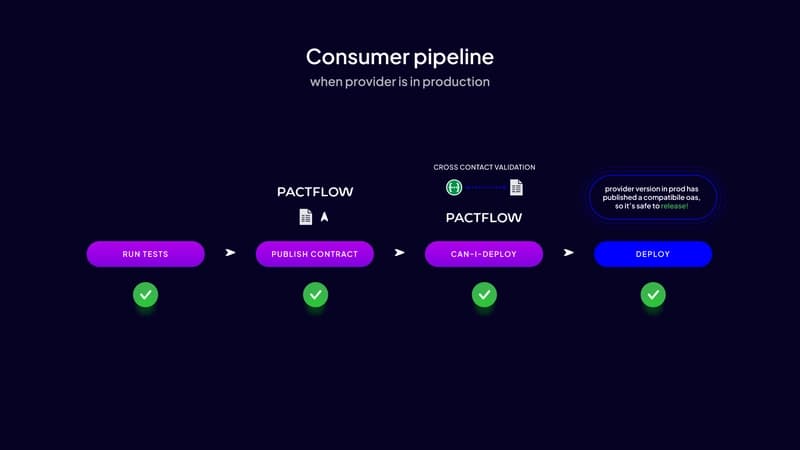
Consumer testing pipeline: Generate contracts, publish to broker, check deployment compatibility
2Phase 2: Provider Verifies the Contract
Now switch perspectives. You're on the provider team (the payment service). You pull the contract from the broker and verify your service meets it:
// Provider verification test
describe('Pact Verification', () => {
  it('validates the expectations of payment-client', async () => {
    await new Verifier({
      provider: 'payment-gateway-api',
      providerBaseUrl: 'http://localhost:3000',

      // Pull contracts from broker
      pactBrokerUrl: 'http://localhost:9292',

      // Handle test data setup
      stateHandlers: {
        'a valid payment card': async () => {
          // Set up test data for this scenario
          await database.seed('valid-card');
        }
      },

      // Publish results back
      publishVerificationResult: true,
      providerVersion: '2.1.0'

    }).verifyProvider();
  });
});
What's happening here?
- 1.Provider pulls the consumer's contract from the broker
- 2.For each interaction, Pact sends a real HTTP request to your service
- 3.Your service responds (with real code, real logic)
- 4.Pact checks if the response matches the contract
- 5.Results are published back to the broker
If your service doesn't match the contract, the test fails. Right there. In CI. Before deployment.
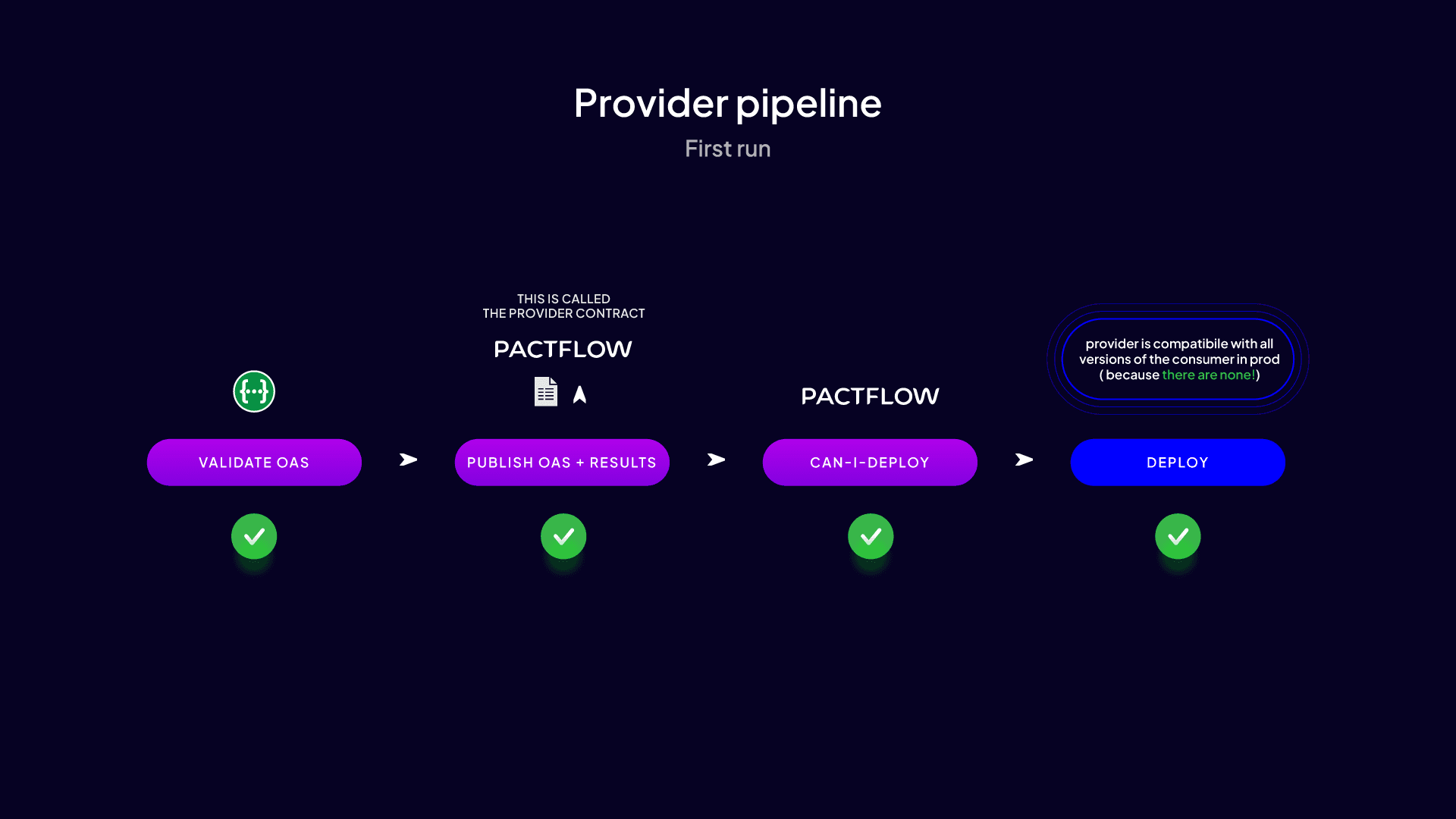
Provider verification pipeline: Pull contracts, verify service, publish results, check deployment
Real-World Scenarios
Let me show you how this plays out in practice. These five scenarios cover the common situations you'll face. Each one teaches a specific lesson.
Scenario 1: The Happy Path ✅
What happens: Consumer needs to process payments. Provider has a payment API. They agree on a contract. Everyone tests independently. Both deploy successfully.
The flow:
- 1. Consumer writes Pact tests → Expects: POST /api/payments/authorize
- 2. Consumer publishes contract to broker → Version: happy-path-consumer
- 3. Provider verifies contract → All 9 interactions pass ✅
- 4. Provider publishes results → Version: happy-path-provider
- 5. Can-i-deploy check → Both services: YES - compatible!
Result: Both services deploy safely. No surprises. No broken integrations.
Key learning: When contracts are clear and honored, deployments are boring (in a good way).
Scenario 2: Backward Compatible Changes ✅
The situation: Provider wants to add a new optional field to responses. Will this break consumers?
What happens:
- 1. Provider adds new field: "processingTime": "150ms" (optional)
- 2. Provider runs verification → All pass ✅ (consumers ignore unknown fields)
- 3. Can-i-deploy check → YES - no breaking changes detected
- 4. Provider deploys → Existing consumers work fine, new consumers can use new field
Result: Safe deployment. Consumers get enhancement without breaking.
Key learning: Adding optional fields is safe. Pact uses "loose" matching – consumers only verify what they care about. Extra fields? Ignored.
Scenario 3: Breaking Consumer Changes ❌
The situation: Consumer developer adds a new feature that expects a field the provider doesn't return.
What happens:
- 1. Consumer adds expectation: { ..., "loyaltyPoints": 150 }
- 2. Consumer's tests pass locally (they're mocking the provider)
- 3. Can-i-deploy check → NO - provider doesn't support this contract
- 4. Provider verification would fail → Missing field detected ❌
Result: Deployment BLOCKED. Consumer can't deploy until provider adds the field.
Key learning: Contract testing facilitates communication. You know what's needed BEFORE anyone deploys. No production incidents. No finger-pointing.
Scenario 4: Breaking Provider Changes ❌
The nightmare scenario: Provider team removes an endpoint. They don't realize consumers depend on it.
What happens:
- 1. Provider removes: DELETE /api/payments/cancel (seemed unused)
- 2. Provider runs verification → Consumer expects /api/payments/cancel
- 3. Provider returns: 404 Not Found ❌ → Verification FAILS
- 4. Can-i-deploy → NO - breaks existing consumer contracts
Result: Deployment BLOCKED. Provider can't deploy until they fix it.
Key learning: You can't accidentally break consumers. The contract verification catches it. In CI. Every time. This is the scenario that saves you from 2 AM production incidents.
Scenario 5: Schema Type Mismatch ❌
The subtle bug: Provider changes a field type. Code still works. Looks fine. But types don't match the contract.
What happens:
- 1. Provider changes: "amount": "100.00" (string) → "amount": 100.00 (number)
- 2. Provider runs verification → Contract expects string, got number
- 3. TYPE MISMATCH detected ❌
- 4. Can-i-deploy → NO - type mismatch detected
Why this matters:
// JavaScript consumers might be doing:
const dollars = response.amount.split('.')[0];  // Breaks with number!

// Or validation:
if (typeof amount !== 'string') {
  throw new Error('Invalid amount format');
}
Result: Deployment BLOCKED. Provider must revert or coordinate breaking change.
Key learning: Types matter. Schema changes are breaking changes. Contract testing catches these subtle bugs that slip through traditional testing.
The Real Benefits (Beyond the Hype)
After working with contract testing for a while, here's what actually changes:
1. Deployment Confidence
Before: "Let's deploy and see what breaks"
After: "Can-i-deploy says yes, we're good to go"
2. Faster Feedback
Before: Bug found in staging (2 days after change)
After: Contract fails in CI (2 minutes after change)
3. Independent Deployment
Before: "Can't deploy until payment team updates"
After: "Broker confirms compatibility, deploying now"
4. Clear Communication
Before: "Did you change the API?" "I don't think so?"
After: "Contract shows you need field X, let me add it"
5. Living Documentation
Before: API docs outdated, Swagger file aspirational
After: Contracts show exactly what consumers actually use
6. Cheap to Run
Before: Integration tests need 12 services, take 45 minutes
After: Contract tests run in 30 seconds, need no external services
Getting Started in Your Organization
Start Small (Please!)
Don't try to contract-test everything. Pick one integration that causes frequent issues, has clear consumer-provider relationship, and a team open to trying new things. Start there. Prove the value. Then expand.
Phase 1: Local Setup (Week 1)
- Day 1-2:Get the broker running with Docker Compose
- Day 3-4:Consumer side - Write one Pact test, see contract generated, publish it
- Day 5:Provider side - Pull contract, run verification, publish results
By end of week: One complete contract, verified, both sides. You've done it!
Phase 2: Add to CI/CD (Week 2)
Now contracts are enforced automatically. No human gatekeeping needed.
Consumer CI:
- → Run pact tests
- → Publish contracts
- → Check can-i-deploy
- → Deploy if compatible
Provider CI:
- → Start service
- → Verify contracts
- → Check can-i-deploy
- → Deploy if compatible
Phase 3: Expand Coverage (Week 3-4)
Add more interactions. More consumers. More providers. Build the contract network. Watch the broker UI fill up. See the compatibility matrix. Feel the confidence grow.
Phase 4: Make It Cultural (Ongoing)
- •Add contract testing to your definition of done
- •Include it in onboarding for new devs
- •Share success stories (blocked bugs, safe deployments)
- •Review contracts in code review
Common Pitfalls (And How to Avoid Them)
Let me save you some pain. Here are mistakes people make:
Pitfall 1: Provider-Driven Contracts
Wrong: Provider writes contract, consumer must comply
Right: Consumer writes contract based on their needs. Consumers drive the contract. They know what they need.
Pitfall 2: Over-Specifying
Wrong: Contract checks every field, exact values, exact order
Right: Contract checks only what consumer actually uses. Use Pact matchers: like(), regex(), eachLike()
Pitfall 3: Skipping State Handlers
Wrong: Provider verification without proper test data
Right: State handlers set up exactly what each test needs. Each interaction gets the right context.
Pitfall 4: Ignoring Can-I-Deploy
Wrong: Generate contracts, never check deployment safety
Right: Block deployments based on can-i-deploy results. The whole point is deployment safety!
Pitfall 5: Not Running in CI
Wrong: Developers run locally sometimes
Right: Every commit verifies contracts automatically. If it's not in CI, it doesn't exist.